The Gate

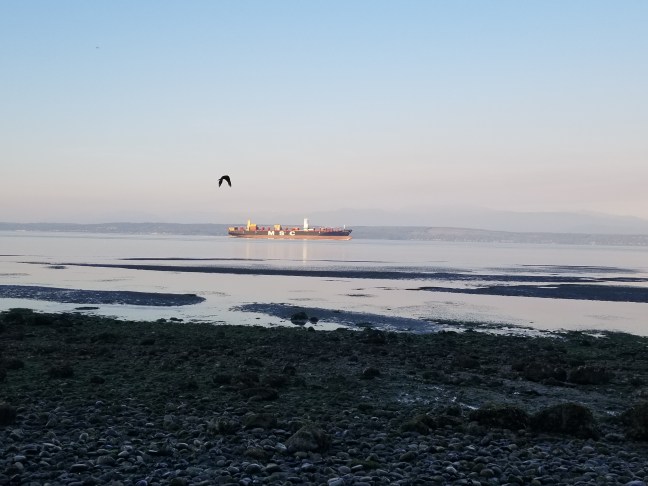
There was a gate that led to the beach in the neighborhood where we were renting. The instructions to access the beach were very clear, and access required a key.

I was met by a tall chainlink gate with a deadbolt for a lock. I inserted the key, opened the gate, and headed to the beach. Once through, it was about 115 steps downward to the water level; a switchback set of steps, riser after riser. This was a rugged beach. A Puget Sound area beach. There were seals in the water at a distance, bald eagles perched on rocks, and also flying above. Ships could be seen heading out to sea and at close proximity. Blackberries were everywhere, draped on the vines, swollen and ripe with no competition for them. There wasn’t another soul to be seen while I was there. Not a single person, except for my family.

The best places and spaces require more work to access and experience; a path less traveled. “Blue water” and “empty spaces” are usually hard to find. They make us sweat. They stretch us. They require effort and intention to access and dwell within, but the experience offered is unique.

The same is true in our businesses, departments, families, relationships, and work. Unlocking the gate, working to get to a differentiated space, takes effort. But there’s no crowd. The crowd prefers the easy route. The commodity route, the crowded space.

What effort are we willing to put forth to be unique, to be differentiated, to define as a niche?

Selling “Experience” – The Gas Stations

There are two service stations in my town. Both are within blocks of each other. Both charge within pennies per gallon of each other for gas. Both are national-level name brands.

One always has receipt paper at the pump. The other doesn’t. One always has full window-cleaning fluid troughs at each pump. In fact, at the one, the fluid smells like Wintergreen. The other rarely has enough fluid, if at all. It smells like regular cleaning fluid.

One has an ample stock of snacks and beverages inside and a clean smell. The other is always under-stocked and has an awful odor like a bad hospital smell inside.

One has nice canopies at the pump stations, well intact, with clean lines. The other always seems to have some maintenance issues going on at the pump stations.

One has uniformed attendants inside that typically respond with a polite greeting. The other has people with no uniforms, and generally a dis-interested person behind the counter.

The price is almost the same at the one or at the other; sometimes even the exact same price. But even if not, it’s worth the extra thirty to fifty cents per fill-up, to use the one.

At which one would you purchase your gas and snacks?

In a commodity business, “the one” has learned at how to differentiate. The other doesn’t care. It is always possible to differentiate within our existing revenue stream and context; to deliver value with some thought and care for the customer’s experience.

How about your business? How about mine? What experience do we want to create? What experience are we delivering?


PRICE IS IRRELEVANT

If the first question a client or prospective client asks about is related to price, then we know that their values are centered around cost. Most attempts to sell them otherwise will not typically work. To this purchaser, value is based on low price, and the product or service is viewed as a commodity. If the client-buyer is interested in what we’ve got, and we aren’t the low price, they may ask us to justify ourselves. I got this question last week “Why are you double the other price? Can you explain why your price is so high?” (This is a downward spiral by the way. Don’t answer the question to try to validate.)

I provided a polite and professional response, but didn’t answer the question exactly. I indicated what value was being provided and how the fee compared to other service-company fees in our category. My response asked the opposite question back, “Why is their price half of ours. What are they so cheap? We are both looking at the same project, right?” Then I explained what was being provided and nothing more.

I didn’t hear back from that client yet. And there’s a good chance that I won’t. They will likely purchase the other provider’s services. Because what this client was really SAYING, not asking, was “Hey, you’re too expensive. I can get the same thing for 40% less.”

So why do I say that price is irrelevant? Because we buy based on our values. Price is the consequence, the manifestation. It’s not the issue. Price or cost-based buying says “any of these firms will do, just get me low price.” The problem with this is that the buyer is assuming that they are getting the identical service from any of the choices presented to them.

It’s never really about price. It’s about the buying mindset and values.

Cost-based buyers want low price. Cost leads the conversation.

Value-based buyers want what they perceive to be the best investment and value for the cost of the purchase. Value and investment leads the conversation, price falls out, sometimes negotiated, sometimes as stated.

Identity, connection, or brand-based buyers, want to identify with a particular person, enterprise, brand or genre. Being connected to the associated values leads the conversation. Price is what it is; “If you want to be connected with us, the fees associated with that are as defined.”

Price is important, but price is really irrelevant. People already know about what they are willing to pay based on their mindset.

What kind of buyer are we seeking to attract?

What values are we seeking to communicate?

How is that portrayed in our brand?

Are we delivering?

Whatever we choose, we need to stick to it and dive deep. Pick a lane and stay in it. We can’t be all things to all people.

Post Project Meetings – Defining Experience

Post project review meetings are arguably the most important project and team meetings in an organization (and a required SOP now at my company) since it defines lessons learned; what we did well, what we did not, how we can improve. It helps identify “the experience” of the team and the client. It’s ALL about the client’s “experience.” The team’s experience is equally important  (client experience is only as good as the team experience and service to each other)

There’s many hotels, restaurants, auto dealers, contractors, engineering firms, professional services corps, ALL TOUTING the SAME THING.

Which one’s do you like to frequent and write checks to? Those with whom you have a positive experience or a negative experience ? Positive experience (gratitude, smiles, fair price, great value, delivering on what has been promised) means repeat business and growth.

Post project reviews are necessary for company and professional advancement.

All progress starts by telling the truth. These meetings are great truth revealers and tellers. We learn and grow through doing, celebrating wins, and fixing problems.

Fast and Cheap?

This was my response to client today (after several emails) requesting us to give our best price for a quick turn and schedule critical project:

I want to be very clear. Best price and immediate start/quick turn do not go together. Quick turn with quality, and fair price for the situation go together. It’s not “fast and cheap”. It’s fast and commensurate with service.

I don’t like to work like my hair is on fire. That happens enough in this biz every day

We will look at what we can do, how or where it can plug in, how quickly we can get it done for you and your team, and let you know. We always like to provide
value, timeliness, and a reasonable approach with the work to our clients
.”

Their response?

“Amen. Good words. You’ll see an RFP soon”

Be clear. Be true. Be candid. Be respectful. Provide value. People appreciate clarity and it makes it easier to improve our ROI on proposals and sales.

Solution Sets 

Schedule & budget are also determining factors in a solution set and in providing problem solving and deliverables to clients. It’s not “provide solutions at any cost and for as much time as they take.” Also speed of response, speed of performance, and prompt project delivery almost always win, and are typically the top or near the top priority for clients.

It’s hard as technical professionals sometimes to consider budget and schedule as equal variables or boundary conditions with other more direct technical issues.

We’ve got to ask ourselves “how can I get this done in the allotted time frame and budget” and use that as part of the boundary conditions around the solution and deliverable.

When we do this on every project and task within the project, it mitigates loss, makes the potentially marginal job profitable, and makes the good one really great.

Every person, on every team, at every level should have this reality in mind. They should be accountable, and also empowered, to call timeout and to take action with the project leaders and principals.

And it means not being a slave to the defined technical and software processes when there’s an issue slowing us down. Remember, procedure and technical tools are supposed to serve us, not the opposite. These days that often gets reversed, spending more time on the process and software functionality than we spend on the problem or creative aspect of the solution.

Provide serviceable solutions while staying in business.

The Token

They reminded me after my doctor appointment that I needed a token (coin) to get out of the parking lot. “Thanks for reminding me,” I said.

In my car, I shifted to reverse to back up and head for the exit. But there was a car behind me, then another and another. I looked around and saw that two lines had formed for one exit. 

One exit had a maintenance truck in it working on the machine for lift the gate that allows the cars to get out of the parking lot. The other lane had a car sitting there, taking some time to deal with the one operable machine. The lines quickly formed and got longer and longer. I wasn’t going to get out any time soon. There was clearly a problem with the car trying to exit. It appeared that the gentleman in the vehicle was struggling to figure out how to use the machine. Everyone was just sitting, waiting, not moving. I thought to myself, if someone doesn’t do something we may be here all day. Perhaps that someone needed to be me. 

So I unbuckled, got out of my car , went to the maintenance guy and asked him if he knew what was happening with the car in the exit line. “I don’t know anything about that,” he said grufly (like don’t bother me dude.) So while everyone sat in their cars and watched, I approached the guy at the exit. I saw he had a credit card in his hand. I asked him, “What’s the problem? Can I help you with something?” 

“I’m trying to get out,” he says.

“You need a token,” I replied 

“I don’t know where mine went, I can’t find it, and I can’t back up,” he said.

Gazing around at the growing line, I said, “Here use mine. I’ll go get another one. You’ve got to get out and it’ll take some time for the line to get smaller anyway.”

“Thank you,” he said

“My pleasure.”

A few smiles and nods greeted me on the way back to my car to lock up and head back into the building. 

As I started my walk back to the building I heard a voice. “Sir! Do you need a token?” It was the maintenance guy. “I found a token on the ground here. No need to walk all the way back.” 

That gruff maintenance guy that seemed to be ignoring everything was actually watching. He somehow had found the coin the guy had dropped. I trotted over, thanked him and hustled straight back to my car. A smile came over my face. Problem solved. Cars moving. Done deal.

As I sat and reflected, it struck me how God sees even the little things. That He who sees a sparrow fall, can see a token as well, and works through others to bless acts of kindness beyond our expectation. When we pay it forward it always produces positive results whether we see it or not. 

Some other applications from this little encounter:

Someone has to initiate. All it took was me, one person, providing a solution to break the jam. What can we do today to provide a solution to someone or something?

“God finds” I call them. Little things and big things so easy to overlook. Positive focus. Unexpected blessings.

How can we pay it forward today? Break the log jam? Help someone? Find the value proposition and act on it?

Sometimes all it takes is one small token.

Shared Reality

Track with me on this…

My business or domain, my reality

Your business or domain, your reality

Our mutual (together) business (work), our “shared” reality

Businesses working together (B2B) need to work in a SHARED REALITY space

If everything is done on one or the others terms, then there’s a one-sided reality. That can create tension, or worse, set up an opportunity for failure.

This has a strong impact on the working relationship

That’s why CONTRACTS MATTER.

We want to drive toward as mutual of a space as we possibly can, and it should be represented in the contract terms and conditions

As much as possible, we should seek agreements that set up for a win-win scenario.

I am to provide the client value in accordance with certain defined terms and deliverables or products. The client provides me with reasonable terms and conditions for value received

And if there’s a relationship, this should be easy. If there’s value expressed, it should be easy.

The shared reality space, the space in the overlapping circles, the closing of the gap, the intersection of the lines, that’s the space to seek. In that space lies the best opportunity for success. There’s potential for the stuff of greatness in that space.


Connectivity and Engagement

A few recommendations related to business, networking, connectivity, engagement:

Be the most connected,

Hardest working,

Fastest responding,

Proactively communicating,

Actively  networking,

Self learning,

Team oriented,

Client focused,

Innovative,

Most engaged,

person in your space.
That’s it today. Do it. see what happens

Communicate back to me

PS: GIVE IT TIME!

Working in a Box 

Our customer has articulated a goal to us. The mission and problem is clearly defined. So we run off in search of a solution. We work like crazy to make it happen. We can feel it coming together. We’re getting excited to share the solution with the client. Then, indeed, the moment comes. We’ve got it. It’s time to share the victory with our client. Our victory. We can’t wait for the moment. The unveiling. We come back with a presentation showing them that we achieved what they wanted….or so we thought…

But it wasn’t their solution. There’s a fail. What’s the fail? We forsake context and parameters. We never really engaged them in the process. We run with what we THOUGHT  we heard. Its like we’re working in a box without communicating. What the solution lacks is context. Maybe they didn’t want those boundary conditions. Maybe they couldn’t install it that way. Maybe they didn’t want those items listed as collateral. Whatever the case may be, if we don’t engage our customer to come up with a solution within a proper context, we have not delivered. It’s like we’re working in a box. This happens way too often. And we’d think with modern communication tools it would be better, but that doesn’t make it a guarantee. 

Good Solutions require integration and communication. They require collaboration. Keep the lid off the box while you’re working.