
Marketing

Today I received a purchase order from a new client. I received a purchase order because one of my colleagues had quoted a project and provided a proposal that met this new client’s needs and expectations.

The reason we were able to write the proposal, was that I had built a relationship with a decision maker, a millennial professional, in this generational business .

The reason I was able to build a relationship, all by phone and email, was because I’d had some conversations about his business, his markets, and his emerging needs.

The reason I was able to have some conversations is that I had posted a relevant Blog article through Glass Magazine to my LinkedIn social media feed. This Blog article on Delegated Design and Experience vs Inexperience, struck a chord with him and he sent me a well-thought response about his pain points, needs, observations. It resonated with him. It spoke to almost his exact experience.

When he sent me the message I replied instantly; within the hour. I used my mobile phone, while working remotely in Florida, to respond in writing to him, and then to call him. We arranged further discussion by phone prior to a strategic board meeting he had. He wanted to communicate the prospects of working together to his board and the “why” behind it; the value proposition; the idea prompted by he Blog. I couldn’t have posted the Blog, without this particular venue and platform being provided by Glass Magazine.

This is an example of marketing today. In telling a story. In making a real connection with someone. In provided relevant content and value. In giving more than is received. The purchase order was just the manifestation, the end result, of the process. It was as a result of the trust, knowledge, and good will built during the process.

I wasn’t interested in “the sale.” I was interested in the relationship.

This is one face of marketing. It is an example of inbound marketing; content marketing. It’s not what I do, it’s part of who I am. It’s the same for you, if you will allow it.
Workflow and Development

There are two basic forms of “workflow” or “new practice” development:

  • That which we create (innovation and new category.) This needs to bring value to clients and they become part “creative partner” with us (from a “what if” and testing scenario).
  • That which our clients require (get competent and optimize)
    • They define
    • We build/design to spec
    • We execute
  • The Truth moving into the future
    • We all need in our businesses to develop one or both of these.
    • It needs to be done while being connected to the market; with the user/client

The details, the building, the success of the service or product, is up to the builders and operators

Playing Not To Lose vs Playing to Win

As we start the year of 2019, I’m curious as to our disposition around this idea of “playing not to lose” vs “playing to win.”

I see both types of people, teams, corporations.

What’s the difference?

If we play not to lose, we are taking a defensive posture. In this posture we can’t actually win, unless it’s by accident (even that’s a stretch.) This is not a good strategy. We often feel comfortable in the “play not to lose” mindset, but it is a false comfort. It’s a “slow death” for a business, a team, a city, a culture, a relationship. This is the space where we don’t take any risks, or keep them really tightly measured. It feels comfortable in that we think it’s designed to not fail. But actually this is planned failure over the long haul. We think that if we do everything we can to not lose, then we will not have to worry about the risk of failure. It doesn’t work that way. If we play not to lose, we’ve already failed at the beginning. It’s just not yet apparent to the participant.

Playing to win involves risks. We MIGHT lose but we might win as well. In fact, we play as if we EXPECT to win. There’s a vulnerability in that space for the person stating their intention, whether to themselves or to those around them. But playing to win is the option that gives us the real opportunity to win. Sure, we may may go down in flames, but I say “better to have tried and to have lost than to have never tried at all.”

Leadership has to create a winning mindset and model it. Leadership is even more vulnerable in that space than others, since it also influences all other people and downstream results that are involved. It’s open to criticism of the onlookers, and to those on the team as well.

I’d rather play to win. To be dynamic. To take risks, to go for it, win or lose, pass or fail. Resilience is the quality I seek; to dust off after the loss or failure and to give it another go; to plug away; to be relentless. Sometimes we may have to call the game or change course at times. That’s okay as well. It happens with forward motion.

Playing to win is active, it’s participatory, dynamic and takes risks. Playing not to lose is on its heels, it’s static, it watches and is risk averse.

The manifestation of either position is rooted in mindset, which is a deep well. It’s subtle to the player, obvious to the viewer and onlooker.

Which disposition are you? What outcomes do you seek?

“Zero-Based” Meetings

You’ve heard of “Zero-Based Budgeting”? You start the year with ZERO in each line item of the budget and build from bottom up. Everything is evaluated from a fresh perspective and nothing is taken for granted in the new fiscal year.

How about we do the same for meetings? I’m just thinking from a “zero based meeting assessment” point of view; meaning everything about meetings, the meeting purpose, scope, duration, participants and value assessment is on the table for re-evaluation year to year or quarter to quarter. We need to ask ourselves if a particular meeting or set of meetings are still worthwhile or not, to see if we are still achieving the intended purpose and corresponding results, or not.

Let’s re-assess our goals and needs for all meetings and start fresh.

The Entrepreneurial Dichotomy

Dichotomy; a contrast between two things

The Entrepreneurial Dichotomy is that our energy, ideas, our vision, are deeply needed, yet our businesses are worth much more without dependence on us; without us having to be present to do transactional things; to not have to handle the day-to-day. We are supposed to be building an enterprise rather than doing a specific job.

Being free to devote our attention to the places where we provide the most value to clients, and to our business, is what creates the best opportunity for everyone to benefit; being unencumbered by everything else to the fullest extent possible

This takes constant effort and intention.

I recommend a “not to do list.” The list facilitates what we are supposed to be doing, and provides a reminder to delegate everything else.

Dynamic change should happen in perpetuity in order to keep this process advancing.

What’s on your not to do list? What’s your focus?

It’s a constant battle and effort to make it happen.

Systems

“That accounting system is great. It helps us track productivity and see “real time” revenue stream, project tracking, and utilization. This is going to really improve our operation.”

“That CRM system is awesome. It’s going to allow us to monitor sales and client activity, hit rates, incoming pipeline. We’ve got this really dialed in now.”

“Those spreadsheets for earned value tracking are so good for operations. All our problems are solved operationally, since we can now know exactly where projects stand at all times.”

Time out. Hold up. Reel it in. Yes, these systems are great. They are necessary for proper management at scale. They are part of best practices in professional services. BUT, they won’t change a thing if the mindset behind the people and the systems stays the same. They are just systems. The proper use and execution of systems from the right mindsets and applications are what helps to change things. The systems are tools, just like any other tools of a trade.

Buying a hammer doesn’t make us a Finish Carpenter. Buying a new stove doesn’t make us a good chef. Buying a tool or a system doesn’t guarantee compliance or results.

Good systems still need thought and sensible people behind them. In fact, in professional services, if given a choice, solid, experienced, smart people will trump a system or process every time. When both are applied together, it’s magic. Checking a box or using automation can make good better, but bad even worse.

Project Psychology

There is much said and written about Project Management. Every project is to have (among other things) :

  1. A PMP: Project Management Plan
  2. A RMP: Risk Management Plan

What about a “CCP” and a “PPP”?

  1. CCP: Client Communication plan
  2. PPP: Project Psychology Plan

You see, each client and each project has unique needs, wants and desires, best identified in the Proposal stage of the project, but manifested throughout. This is true at “B2B” (business to business) level and “P2P” (person to person). You see, also, each project has a “mind” of it’s own; multiple constituents within the context of the project, differing goals and values, some within our sphere and some outside of it. So often projects become “triage mode” or “tyranny of the urgent” because we are focused on “checking the boxes” and not dealing with the essence, the mindsets, the commitments of others, the “psychology” of the project.

The more we align with client expectations, understand the dynamics of the project, the mindsets, the conflicting priorities, the more our “box checking” effort (within our process) is just a matter of consequence and documentation. Because “checking the box” within our processes doesn’t deal with “the why’s” within each project. It only memorializes activities.

How’s our understanding of project and people dynamics? This has influence over the quality of a project manager’s life and the quality of project produced.

SWOT Analysis – Threat to Opportunity

Threats that are defined in our SWOT analysis can actually be opportunities in disguise. Recently in a SWOT analysis review with one of our branch offices, the leader was reviewing a legitimate threat that influences our office’s ability in that market to procure work with certain clients.  I immediately noted that the threat was actually a veiled value proposition, an opportunity. If we could sell the clients on what we know about that space in the supply chain, we would actually do the supplier causing the threat a favor, and make more value for our clients as well. It’s just a different pricing paradigm on the front end in order to achieve a better bottom line for them in the future. It’s a win, win, win if discerned and communicated correctly. Now comes the hard work of communicating the value and overcoming entry barriers; getting referrals; designing a pricing structure and a delivery method.

Some threats are hidde opportunities. Like a “no” in sales and “risk” in innovation. We need to go beyond the surface and figure out if these things are worth pursuing.

Have you dug below the surface?

The Gate

There was a gate that led to the beach in the neighborhood where we were renting. The instructions to access the beach were very clear, and access required a key.

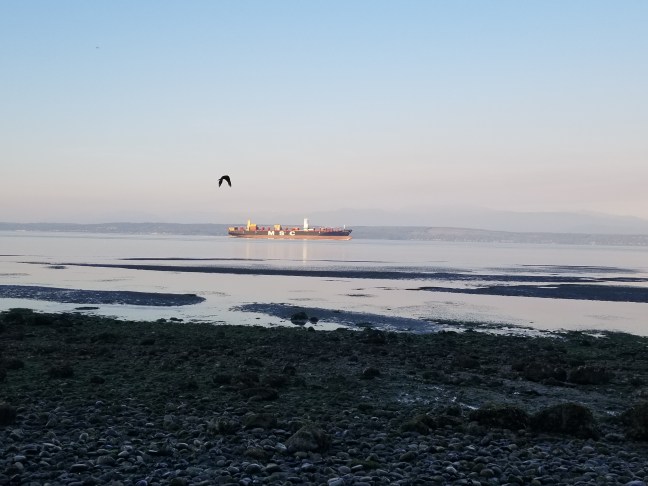
I was met by a tall chainlink gate with a deadbolt for a lock. I inserted the key, opened the gate, and headed to the beach. Once through, it was about 115 steps downward to the water level; a switchback set of steps, riser after riser. This was a rugged beach. A Puget Sound area beach. There were seals in the water at a distance, bald eagles perched on rocks, and also flying above. Ships could be seen heading out to sea and at close proximity. Blackberries were everywhere, draped on the vines, swollen and ripe with no competition for them. There wasn’t another soul to be seen while I was there. Not a single person, except for my family.

The best places and spaces require more work to access and experience; a path less traveled. “Blue water” and “empty spaces” are usually hard to find. They make us sweat. They stretch us. They require effort and intention to access and dwell within, but the experience offered is unique.

The same is true in our businesses, departments, families, relationships, and work. Unlocking the gate, working to get to a differentiated space, takes effort. But there’s no crowd. The crowd prefers the easy route. The commodity route, the crowded space.

What effort are we willing to put forth to be unique, to be differentiated, to define as a niche?

Our “Why”

It truly is always about “The Why”…the essential reason, the purpose, that clarifies our “what” our “context.” (Thanks Simon Sinek)

For instance, when my partner and I built our most recent office space, we wanted to support a new expression of our vision, one that would also permit us to grow, to showcase our brand, to attract and retain talent, to host clients within, and to be happy to work from every day. We also wanted some flexibility of space and options. We wanted to express a more refined version of our trade-marked brand of “Creating Structure.” We wanted to facilitate more collaboration, more inclusiveness, more connection. We wanted the building to functionally express our “why” within its surroundings and architecture. We defined a budget and we got what we envisioned. The same is true with our company’s branch offices. We want them to be the best expression of our values, for the context within their geography.

Everything we do as people comes from the internal expression of who we are, why we think we exist, and from where our identity is defined. What we do (the behavior) is driven from who we are (our identity.) And everything we do should be with thought; it should point to our purpose and mission. It should express our brand in tangible ways. In fact, it does whether we know it or not.

Why not make it intentional and meaningful? Why not do all that we can to support our “why” in everything we do?